Getting a BA or BSc at University College Roosevelt in Middelburg
Looking for the facts?
See programs, tuition, admissions and scores for University College Roosevelt.
Associated with
Degrees
Concentrations
Location
English
Cost for out-of-European Economic Area (EEA)
On-campus housing cost
FAFSA funds
Abroad from abroad
Student body
Five adjectives
Life in Middelburg
In May 1940, Dutch and French troops on the Western Front near Middelburg held off a German attack for eight days. Ultimately, the entire province of Zeeland, in the Netherlands’ balmy Southwest, was defeated and 600 buildings near what is today’s campus were destroyed. To add insult to injury, the bombing sparked fires which were not fully extinguished for 40 days.
When the smoke cleared, Middelburg’s damage was surpassed only by the devastation that Rotterdam suffered during the war. However, there’s been plenty of time since the German occupation to watch Middelburg stage its comeback.
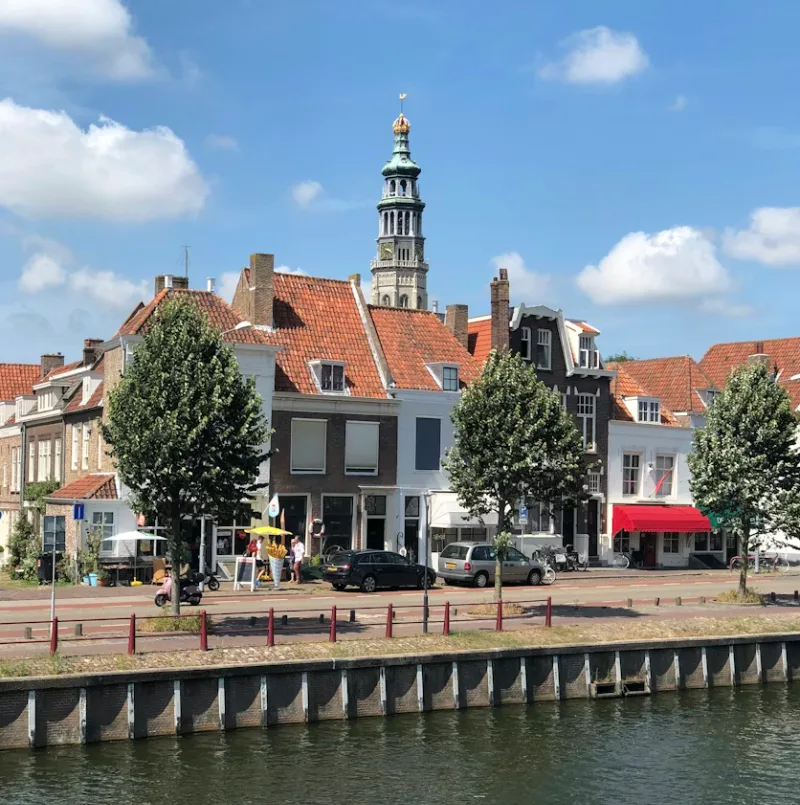
The medieval market town has reemerged into an historical and artistic super-town on the southwest coast of the Netherlands, jutting out on a peninsula into the North Sea. Middelburg is home to 50,000 people and the metro area includes Vlissingen, an adjacent beach community with 50,000 more, making the urban zone large enough to be full of resources for students. However, one international student says Middelburg is “barely big enough to be called a city in my eyes…and it’s generally quite quiet.”
In addition to feeling small and unassuming, the city feels historic despite its post-War restoration. The gothic former town hall, now home to UCR orientation week events, overlooks a typical Dutch market square flanked by architectural gems. A nearby 12th-century abbey, for example, houses the Zeeuws Museum where you can contemplate Zeeland’s rich trading past enriched by the Dutch East India Company.
Side streets are bustling with everything from H&M to local pizza (even global staples like Dominos and Subway). Foodies will be overwhelmed with independent choices, too, from gelato and crepes to craft beer. On Thursdays and weekends, market stalls are lined with snacks like bolus, the regional cinnamon sticky buns that originated with Jewish bakers of Zeeland in the 17th century.
One nearby bookstore café, De Drvkkery, is the perfect spot to catch a reading, a cappuccino, and a round of Codenames. There’s a vintage cinema for movie lovers and a bowling alley to keep up your game. If you’re not ready to go home, you’ll likely end up at Café Rooie Oortjes or Café ‘t Schuttershof for live shows and dancing. Students getting oriented to the town might choose to take a tour boat ride or rent a canoe for an independent orientation to the charming canals of Middleburg.
There are outdoor recreation opportunities along the Zeeland coast that students will not find at the other university colleges in the Netherlands. Adventurers can learn to surf (and try kite or windsurfing) on the blustery North Sea beaches a 40-minute bike ride from campus. There is a sprinkling of surf schools and rentals on the north side of town alongside beaches facing both the open water and protected inlets catering to new learners. Northside beaches also serve sun-seekers (this is the most you’ll see anywhere in the Netherlands, with 1650 hours per year). Oostkapelle Beach is always ranked high among Dutch beaches for its white sand, nature preserve setting, and long stretch of beach where visitors can space out and watch the kite surfers take off in the constant, blustery wind. Those looking to ogle the world’s largest storm surge barrier, the Delta Project, can also have at it on the northern beaches of a dry and safe Zeeland.
The area, with its many beaches, is a tourist destination within the Netherlands but isn’t yet on the radar of international tourists. In fact, it’s one of the more “provincial” areas of the Netherlands, where students say that learning Dutch can be useful when speaking with non-students, but is not necessary.
In spite of being part of the Netherlands’ “Bible Belt” of comparatively conservative Calvinists, students say that the town has a visible LGBTQ community and is very progressive.
Campus + Housing at University College Roosevelt
The Roosevelt family (of American fame) came from Zeeland stock, and their presence is still seen in the boutique hotel, The Roosevelt, as well as the university’s citizenship theme. This small liberal arts and sciences honors college affiliated with the University of Utrecht oozes respect for the family’s ideals and roots, and the emphasis in the curriculum is on contributing to a collaborative, diplomatic world. In Roosevelt’s case, the small, international student body and pick-mix coursework does emphasize cross-border discussion and problem-solving.
Campus buildings stretch across five Roosevelt-themed buildings close to the city center. For example, Eleanor boasts the computer lab. Franklin is the university’s slice of the old town hall, with a stunning, church-like reception hall. Theodore houses classrooms and a museum dedicated to the man who invented the telescope in 1608 here in Middelburg (way to go, Hans Lipperhey). The university’s outdoor classroom greenspace is watched over by both Franklin and Eleanor statues though it was conceived as an extension of the Greek outdoor classrooms of Aristotle, who was known for teaching outside.
Ultimately, the campus and residences are spread throughout the city, tucked into little corners that make living in Middelburg and attending UCR indistinguishable. Plentiful campus bike sheds and parking rooms cater to a Dutch sensibility that getting across town for class should take a quick three minutes and involve a bicycle.
University College Roosevelt has four dorms, where all students, regardless of year, live in close communities. Housing is guaranteed all three years, with no need to move out over the summer. Roosevelt offers rooms with a variety of different configurations from shared bedrooms in traditional dorm style with kitchens and bathrooms to row houses with clean, safe rooms and adorable terraces. Students can move to a different campus location or stay in the same room for the duration of the program if they choose.
You’ll get help moving into that unfurnished room from an organized furniture market before Intro week, and a Facebook group for buying and selling throughout the semester. There is a second-hand bike market in person as well as a thriving market online and on social media.
Perhaps because Middelburg is not known as a university town, students run a variety of programs for themselves in order to meet other students. They are the driving force behind the student center, which includes a student-run bar, restaurant, and a basement party space.
Roosevelt’s student association has societies from theater to sports, debate, LGBTQ+ topics, med affairs, cooking, gaming, and even to interact with Middelburgers through camping, food crawls, volunteering, and generally working to “burst the UCR bubble.” The small student population in Middleburg also supports incoming students by maintaining updated resource lists on the student intranet system, which can help direct newcomers to medical care and other logistics of living abroad.
Academics
Roosevelt is known for its rigorous academic atmosphere. There are four majors in the 3-year program, and students take four courses per semester (each worth 7.5 ECTS in the European Transfer and Accumulation System). This is the reason for much of the stress: semesters are a dense 15 weeks and each course comes with a heavy load. Students have been working to call attention to the pressure this creates and brainstorm solutions to the problem. For its part, the school is upfront about the intense academic commitment it expects; it warns potential applicants that they’ll spend ten hours on homework in each course per week, for a total of 40 hours of work outside class time.
Courses are typically structured as two hour class sessions twice a week. They all fall within four main departments in the small college: Arts and Humanities, Engineering, Science, and Social Science (a combination major comprising two of these areas is possible). Within their broad major area, students focus on two or three “tracks,” which are disciplines, in the same course of study, like analytics, art history, environmental science, or anthropology. It’s all capped with a 2-semester senior project.
While choosing personalized tracks from UCR’s roster of 200 courses is the main focus of the program, some coursework is required: freshman rhetoric (writing and presenting) and a statistics and methods course. You’ll have an academic advisor, called a “tutor,” helping you choose courses every semester and meet graduation requirements in your major. With 90% of the student body going on to graduate school, UCR tutors help prep seniors for what comes next and for how to structure their studies to be attractive candidates to graduate school programs.
Though the program offers maximum flexibility in course selection, getting into classes that are not in your track can be difficult. Students choose courses but later find they have been kicked out to accommodate high demand. A waitlist means that some students can get back into desired courses. Ultimately, the small university college community does not have unlimited courses available, nor unlimited room in those courses, and students in the major trump elective-takers.
There are a couple of special programs that can enhance your major and UCR is a great choice if you’re interested in any of them. The “Going Glocal” track involves spring coursework and a summer program out of the country, focusing on global issues and development (a different country and topic is featured each year). In 2022, for example, students will take one prep class at UCR on “Global Justice and Activism” and then a practical course over the summer in Mexico. UCR also offers a music performance track. The program involves an entrance exam and the subsequent chance to enjoy Europe’s only English-taught performance music-centered bachelor’s studies. Finally, a pre-med program combines life sciences and biomedicine in order to prepare students for a Dutch medical master’s program or foreign med school admission.
Applying
Non-EU students can apply from October 1 - April 1 and should expect a conditional offer if they have not completed their diplomas. July 1 applications are considered for spring semester. Studielink is the nation-wide Dutch college applicant system where students can sign up to apply to all the university colleges. You’ll upload transcripts, one reference letter, and a letter of motivation that might all lead to an interview (online if you’re not in Belgium/Netherlands).
Accepted? The move-in process is lengthy and flexible, so students can arrive through most of August ahead of orientation week.
There is a UCR scholarship for non-EU students, or students from Romania/Bulgaria, for whom tuition is prohibitive, and recipients can apply for interest-free loans for their second and third years. There is some scholarship support for students coming into the new engineering major as well.
Check out safety, cost of living, and more.
See scores that put University College Roosevelt in context.
Read next
More university guides
Related schools
Similar in academic strength to University College Roosevelt, with picks in Netherlands first.